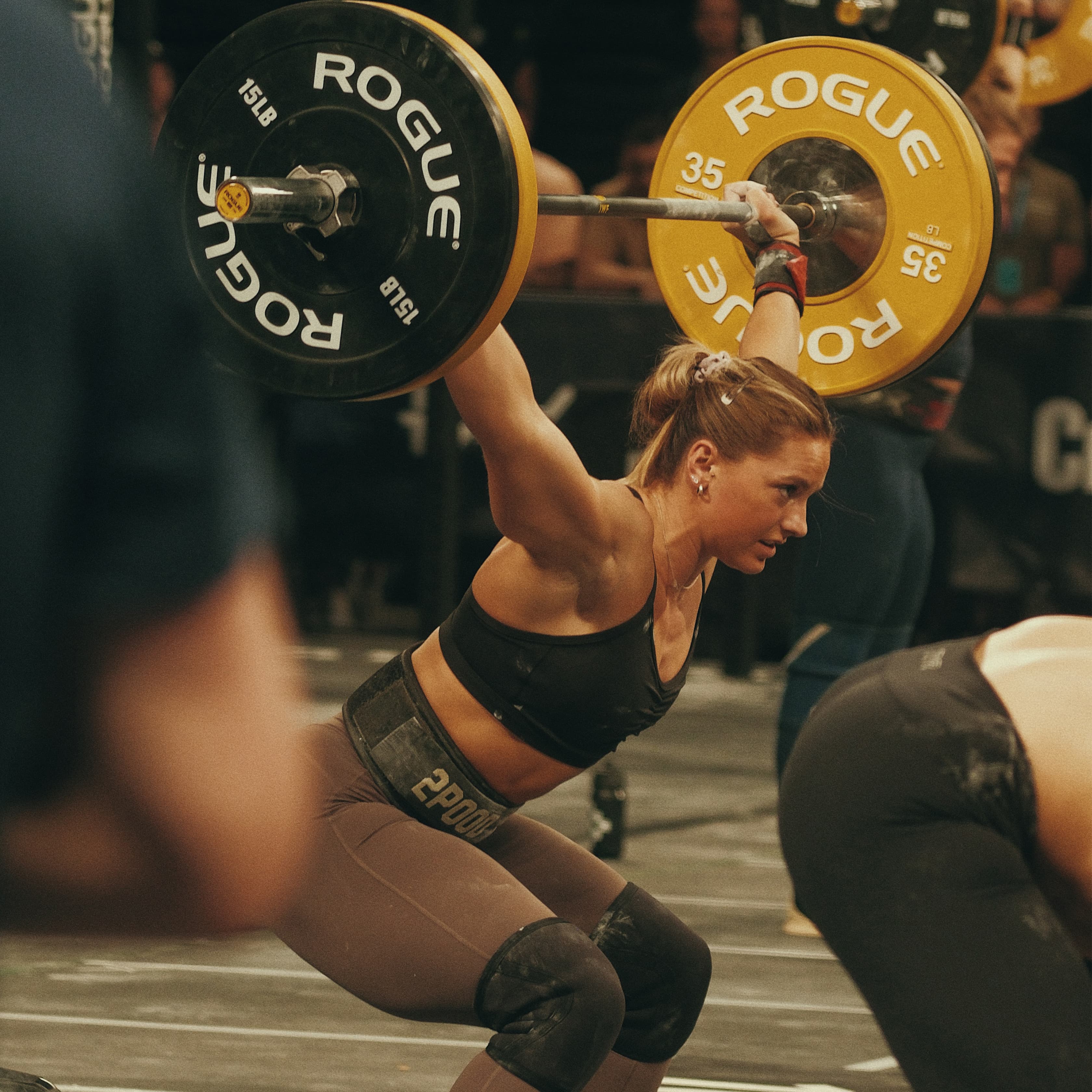























If you’ve ever watched a Hyrox race online or witnessed the pure chaos and adrenaline IRL, then you’ll know that the sandbag lunge station can make even the most elite athletes slow to a crawl.
They might only take up 100m of your Hyroxrace, but sandbag lunges can be one of the most challenging stations to master, especially if you haven’t trained for them efficiently during your prep phase. By the time you reach them, your legs have already been tested through six kilometres of running and six demanding workout stations: Your battery is drained, your legs feel like jelly, and suddenly the sandbag that felt manageable in training suddenly feels much heavier.
Analysis of Hyrox race data has shown that sandbag lunges can be a valuable opportunity to improve your overall race time. So while stations like the sled push often get the most attention during your training program, small improvements in your lunge technique, pacing, and efficiency can add up when every second counts [1].
It’s not just the weight of the sandbag. It's the combination of strength, balance, mobility, and endurance required to keep moving efficiently, rather than breaking or pausing during the workout, after you've already pushed your body through most of the race.
Whether you're preparing for your first Hyrox or looking to improve your station and course times, learning how to approach sandbag lunges properly can make a huge difference.
In this guide, we'll cover:
What sandbag lunges are
The different weights of HYROX sandbags
How to perform your weighted lunges with correct technique
The muscles worked during sandbag walking lunges
Common mistakes that can slow you down
What Are Sandbag Lunges?
Sandbag lunges, also known as sandbag walking lunges, are a unilateral lower-body exercise where you carry a weighted sandbag across your upper back while performing alternating walking lunges over a set distance.
Unlike a stationary lunge, each repetition is performed by stepping directly into the next, creating a continuous line of movement. The added weight challenges your balance, co-ordination and core stability, while also placing greater demand on your legs and cardio system than bodyweight lunges alone.
In a HYROX race, you'll need to complete 100 metres of sandbag walking lunges. It's the seventh of eight workout stations and comes after:
6 x 1km runs
1000m SkiErg
50m Sled Push (4 x 12.5m laps)
50m Sled Pull (4 x 12.5m laps)
80m Burpee Broad Jumps
1000m Row
200m Farmer's Carry
That's 100 metres of weighted lunges with just one workout station (wall balls) and two 1km runs left to go. Needless to say, your legs have already done a lot of work.
Because of this accumulated fatigue, you may discover that the station feels much harder than it does in training. In fact, one of the most common themes shared by HYROX competitors online is that they don't struggle with the weight itself, but with keeping the sandbag stable and maintaining consistent technique once fatigue kicks in.
The goal isn't simply to finish the 100m as quickly as possible. It's to move efficiently, minimise unnecessary stops, and meet the movement standards on every rep.
How Heavy Are The Sandbag Lunges In HYROX?
The weight of the sandbag depends on your HYROX division.
Division:
Open Women: 10kg
Open Men: 20kg
Pro Women: 20kg
Pro Men: 30kg
Doubles & Relays:
Women’s Doubles & Relay: 10kg
Men’s Doubles & Relay: 20kg
Mixed Doubles & Relay: 20kg
In same-sex Doubles, athletes use the same weights as the Open division, meaning Women's Doubles uses a 10kg sandbag and Men's Doubles uses 20kg. In Mixed Doubles, both athletes use the Women's Pro (and Open Men’s) weight of 20kg.
What Stays The Same
Regardless of division and weight of the sandbag, the movement standards stay the same.
The sandbag should rest across your upper back and shoulders, rather than being carried in front of your body, and you must complete the full 100 metres of walking lunges before moving on to your next 1km run if competing solo. If you’re competing in a doubles race, you can share the distance between you: just make sure that your transitions are clean, and you’ve practiced them in training; otherwise, you’ll risk time penalties.
While the weights might not sound intimidating on paper, context is everything. Carrying 20kg or 30kg through 100 metres of lunges after nearly an hour of racing at high intensity and under fatigue feels very different from performing fresh reps in the gym.
Many experienced racers recommend practising with a slightly heavier sandbag during training. If race day weight feels familiar or even light by comparison, you're more likely to stay composed when fatigue sets in. Just be sure not to sacrifice technique for load.
How To Do Sandbag Lunges
Sandbag walking lunges might look straightforward, but they're one of the easiest HYROX exercises to lose time on. Small technical errors can quickly add up, especially when you’re losing energy fast.
The goal isn't to move as fast as possible. Instead, focus on staying controlled, maintaining a consistent rhythm and meeting the movement standards every step of the way to avoid time penalties.
Step-by-Step Instructions:
Position the sandbag evenly across your upper back and shoulders.
Hold the outside handles or ends of the bag to keep it secure.
Stand tall with your chest up and engage your core.
Look straight ahead rather than down at your feet.
Step forward with one leg, landing through your heel or midfoot.
Lower your body under control until your back knee gently touches the floor, creating 90-degree angles with each leg.
Keep your front knee tracking over your toes and your front heel planted.
Drive through your front foot to stand back up.
Bring your back foot through into the next step.
Continue alternating legs until you've completed your distance.
Top tip: Rather than thinking about completing one lunge at a time, try to establish a steady walking rhythm. Consistent, controlled steps are usually faster than rushing a few reps at the beginning then needing to stop and recover.
Continuous vs Resetting Walking Lunges
HYROX sandbag lunges follow a similar movement pattern to an ordinary walking lunge, with each step taking you forwards. If you're comfortable with the movement, you can move directly from one lunge into the next to maintain a continuous rhythm.
However, if you're a beginner or find your balance and technique start to suffer under the added weight or fatigue, take a pause between lunges and briefly bring your feet together to reset. You'll still be moving forwards, but that extra touch can give you a moment to regain your balance and brace your core without coming to a complete stop.
Practise both approaches in training to find the rhythm you can maintain when your legs are tired, not just the one that feels fastest when you're fresh.
Reset Walking Lunges
Find Your Sandbag Position
The sandbag needs to remain across your back during the HYROX station, but there is some subtle adjustments you can make to find the position that feels comfortable for you.
Similar to positioning a barbell for a back squat, you may prefer the bag to sit higher across your upper traps or slightly lower across your upper back. Your shoulder mobility, build and personal preference can all influence which feels most secure.
Whichever position you choose, the priority is keeping the sandbag stable without having to constantly readjust it. Experiment during training and settle on your preferred position before race day.
Practise Your Sandbag Handover For Doubles
Competing in HYROX Doubles? Don't leave the handover to race day.
As both athletes can share the 100m of sandbag lunges, a smooth transition can save valuable seconds and help you avoid unnecessary stops. Practise deciding where you'll switch in advance, communicating the change clearly and transferring the sandbag in a controlled way.
Rather than dropping the bag and having your partner reposition it from scratch, practise a consistent handover technique that allows your teammate to get the sandbag securely onto their back and continue moving as quickly as possible while still adhering to the movement standards.
It's also worth practising your handovers when you feel the same level of fatigue as you would by station seven. A transition that feels seamless at the beginning of a training session can feel very different after a hard run or several rounds of lunges. The more familiar the process is for both athletes, the less you'll have to think about it on race day.
Coaching cue from our resident Lifting Club coach and multi-HYROX competitor participant Zach Watson:
“Watch an elite division race and you'll notice the athletes rarely sprint the station. Instead, they stay upright, take consistent stride lengths, and avoid unnecessary pauses. The smoother your movement, the less energy you'll waste correcting your balance or repositioning the sandbag. That’s the aim.”
Rule Check: Do You Touch The Floor With Your Knee?
Yes. In HYROX, your rear knee must make contact with the floor on every repetition.
You'll also need to reach full hip and knee extension before taking your next step, aka standing back up to an upright position. If you don't meet either movement standard, your rep may be judged as a no-rep, meaning you'll need to repeat it before moving on.
Instead of slamming your knee down hard into the floor as you lunge down, focus on keeping the tension in your legs and controlling the descent to a light, controlled tap at the bottom.
Common Mistakes NOT To Make
Taking steps that are too long
Even strong athletes can struggle with sandbag walking lunges if their technique breaks down. Here are some of the most common mistakes to avoid, starting with your stride length.
Long strides mean you have to travel through a greater range of motion, making every rep more demanding. Instead, aim for comfortable, repeatable steps that allow you to stay balanced and keep moving forward.
Letting the sandbag move around
One of the biggest frustrations shared by HYROX athletes is constantly having to stop and adjust the sandbag.
Before you start, make sure it's sitting securely across your upper back, as even as it can be, and grip it firmly enough to minimise movement without wasting energy squeezing it.
Leaning too far forwards
As your legs fatigue, it's tempting to lean over to help yourself stand up.
Unfortunately, this shifts more work into your lower back to get you back up, throws your balance off and can make breathing feel harder. Stay tall, brace your core and keep your chest shining forward throughout each rep.
Letting your knees cave in
Knees caving inward (knee valgus) during lunges can put excess stress on your joints and kneecap, which can cause pain and ligament strain over time [5]. Your front knee should track in line with your toes rather than collapsing inwards. This improves stability and helps you produce force more efficiently.
Looking down
Watching your feet can cause your upper body to round forwards and throw off your balance. Easier said than done, but try to keep your eyes focused a few metres ahead instead.
Starting too fast
It's easy to get caught up in race adrenaline and attack the first few lunges.
However, many athletes find themselves "hitting the wall" halfway through the station after burning through too much energy early on.
A steady pace from start to finish is usually quicker than stopping multiple times to recover.
Sandbag Walking Lunge Variations To Add To Your Routine
If you don't have access to a sandbag during your training sessions, or simply want to build strength from different angles, these variations can help.
1. Barbell Walking Lunges
No sandbag? Barbell walking lunges should be your first port of call. Of all the variations on this list, they're the closest to HYROX sandbag lunges in terms of weight placement and distribution, with the load sitting across your upper back and shoulders. They also allow you to progressively increase the weight, helping build the lower-body strength and muscular endurance needed for race day.
How to: Position a barbell securely across your upper back, brace your core and alternate stepping forwards into a lunge, lowering your back knee towards the floor before driving back up and into your next step.
2. Bodyweight Walking Lunges
This variation is perfect for beginners learning the movement pattern. With no added weight, you can focus on taking one controlled step at a time while developing the balance, upright posture and technique you'll need before adding load.
How to: Stand tall with your hands by your sides or on your hips, step forwards and lower your back knee towards the floor before pushing through your front foot and stepping straight into the next lunge.
3. Front Rack Sandbag Lunges
Switching the position of the sandbag can introduce a different challenge. For front rack sandbag lunges, the bag sits horizontally across the front of your chest and shoulders. This shifts the load forwards, increasing the demand on your core and upper back while encouraging you to maintain an upright torso.
How to: Hold the sandbag securely across your chest and front of your shoulders, brace your core and alternate stepping forwards into lunges while keeping your chest lifted.
4. Reverse Sandbag Lunges
Stepping backwards rather than forwards places slightly less demand on balance, making reverse lunges a useful progression if you're still building confidence with loaded lunges.
How to: Position the sandbag across your upper back, step one foot backwards and lower your knee towards the floor before driving through your front foot to return to standing, then switch sides.
5. Bulgarian Split Squats
This single-leg strength exercise targets the quads and glutes needed for powerful walking lunges while making it easy to progressively increase the load as you get stronger.
How to: Place the top of one foot on a bench behind you, then bend your front knee to lower your body towards the floor before pushing through your front foot to return to standing.
6. Dumbbell Walking Lunges
Another accessible alternative if your gym doesn't have sandbags. Holding dumbbells by your sides trains your lower body while adding a grip-strength challenge, which can also transfer to other HYROX stations such as the sled pull and Farmer's Carry.
How to: Hold a dumbbell in each hand with your arms by your sides, then alternate stepping forwards into lunges while keeping your torso upright and the weights controlled.
7. Deficit Lunges
Performing lunges from a small raised platform increases the range of motion, challenging your strength and mobility through a deeper lunge position. This makes them a useful accessory exercise for developing strength throughout the full range of motion needed for your sandbag lunges.
How to: Stand on a small raised platform, step forwards and lower the back leg into a deeper lunge than you would from the floor, then drive through your front foot to return to the starting position.
Sandbag Lunges Training Tips (Hybrid & HYROX Training)
Like any HYROX station, the best way to improve your sandbag lunges is to train them with purpose. Simply adding a few sets to leg day probably won’t cut it. They need to be added to your training in ways that mimic how they'll feel on race day, when your heart rate is elevated, and your legs are already fatigued.
Here are a few ways to make your training more race-specific.
Practise Sandbag Lunges After Running
One of the biggest mistakes first-time HYROX athletes make is only practising lunges when they're fresh.
The reality of HYROX is that you reach the sandbag station after running 6km and completing six workout stations. Your legs won't feel fresh, and your breathing certainly won't be under control.
To better replicate race conditions, include compromised running (running immediately after a fatiguing functional exercise) in your training.
Try a session like:
800m run
25m sandbag walking lunges
Repeat 4 times
This teaches your body to maintain strong movement patterns when fatigue starts to build, making race day feel far more familiar.
Occasionally Train With a Heavier Sandbag
Training with a slightly heavier sandbag than you'll use on race day can help build confidence and improve your strength endurance.
That doesn't mean every session needs to be heavier. Your priority should always be practising good technique at race weight first, before introducing heavier loads strategically.
Build Your Upper Back Endurance
Although your grip isn't working as hard as it would during the Farmer's Carry, your upper back and shoulders still have to stabilize the sandbag for 100 metres.
Exercises like:
Zercher carries
Front rack carries
Back squats
Sandbag carries
can all help improve your ability to stay upright throughout the station.
Strengthen Your Core
A strong core helps prevent the sandbag from pulling your torso forwards as fatigue sets in. Training your deep core muscles will build strength from the inside out, helping you stay braced and upright through each lunge.
Exercises worth including alongside your HYROX training include:
Planks
Pallof presses
Dead bugs
Front rack carries
Remember, your core's job isn't just to aid with movement; it's to resist it.
Practise Race Standards
One of the easiest ways to lose time is by completing reps that wouldn't count in competition.
During training, make every repetition race legal by ensuring:
Your rear knee touches the floor.
You fully extend your hips before taking the next step.
You stay in control throughout the movement.
If these standards become automatic in training, you won't have to think about them when you're racing.
Find Your Rhythm
You don't need to sprint through the station to post a fast time.
Many experienced HYROX athletes like Zach recommend focusing on a smooth, repeatable cadence instead. Keeping your stride length consistent and limiting unnecessary stops often leads to a faster overall station time than charging the first few metres before grinding to a halt.
Sandbag Lunges Race Day Tips (accordion)
Recover Your Breathing Before You Pick Up the Bag
The station begins immediately after your run, but taking a second or two to regain control of your breathing with deep breaths can pay dividends.
Starting with a calmer breathing pattern makes it easier to brace your core and stay composed throughout the lunges, minimising the chance of any sloppy reps.
Get the Sandbag Comfortable First Time
Taking an extra few seconds to position the sandbag properly is usually worth it.
A poorly positioned bag will continue to shift throughout the station, forcing you to stop and readjust when you'd rather be moving.
Don't Chase Other Athletes
It's easy to speed up if someone overtakes you, but sticking to your own pace is often the smarter strategy.
Remember, you still have another kilometre to run after completing the lunges.
Break the Distance Into Smaller Chunks
Rather than thinking about completing the full 100 metres, focus on reaching the next line, cone or landmark. Or even number of lunges in your head.
Breaking the station into smaller sections can make it feel much more manageable, especially when fatigue is high.
Keep Moving
Even if your pace slows, avoid stopping unless you absolutely have to. A slower, continuous rhythm is almost always faster than repeatedly stopping to recover. You’ve practised for this, you’ve got it.
Stay Relaxed
Tension wastes energy. Try to keep your shoulders relaxed and your grip firm, but not squeezing the handles. You’re aiming to maintain an upright posture and perform fluid, smooth reps, not rigid, tense ones.
What Muscles Do Sandbag Lunges Work?
Quadriceps: Your quads are responsible for extending the knee as you push yourself back up from each lunge. They're one of the primary muscles working throughout the station and are often the first to feel the burn.
Glutes: Your glutes generate power as you drive forward into each step while also helping stabilise your hips throughout the movement. The longer the stride, the more your glutes work.
Hamstrings: Although they aren't the prime movers, your hamstrings work alongside your glutes to control each descent and assist with hip extension. Crucial for passing the movement standards.
Core: With a sandbag resting across your shoulders, your core has to work continuously to keep your torso upright and resist collapsing forwards. A strong brace can also make the bag feel more secure, reducing swaying or wobbling.
Hip Stabilizing Muscles: Walking lunges are performed one leg at a time, meaning the smaller muscles around your hips have to work hard to keep your pelvis stable and prevent your knees from collapsing inwards.
Calves: Your calves help you stay balanced as you transition smoothly from one step to the next. The constant stepping demands more ankle control, forcing your calves to work hard to keep the wobbles at bay.
Upper Back and Traps: Unlike a Farmer's Carry, grip strength isn't usually the limiting factor during sandbag lunges because the bag rests across your shoulders. However, your traps
What Are The Benefits Of Doing Sandbag Lunges?
Builds Unilateral Leg Strength
Whether you're training for your first HYROX or simply looking to build unilateral lower-body strength, sandbag lunges are one exercise you’ll want to incorporate in your workouts.
Because each leg works independently, walking lunges help identify and reduce strength imbalances between your left and right side. Over time, this can improve movement efficiency and reduce injury risk, creating balanced leg strength [2].
Improves Core Stability and Balance
The sandbag's awkward shape means your body is constantly making small adjustments to keep it balanced. Loaded carries and unstable loads have been shown to increase trunk muscle activation, requiring the core to resist movement rather than simply bracing in a static position [3].
And unlike bilateral exercises such as squats, every lunge challenges you to balance on one leg. Carrying a shifting sandbag only increases this demand, forcing your core and stabilising muscles to work harder.
Develops Endurance For Training Under Fatigue
Completing 100 metres of continuous walking lunges requires your legs to keep producing force long after they'd rather stop. Building this type of muscular endurance is essential for HYROX, where every station leaves you feeling more fatigued.
One lesson many HYROX athletes learn quickly is that exercises feel very different when they're performed after several kilometres of running.
Including sandbag lunges in compromised sessions, where you run before lunging, or performing them at the end of a taxing workout will help your body adapt to producing good movement patterns under fatigue. This is what we call the principle of specificity, which suggests that training movements under conditions similar to competition is one of the best ways to prepare and improve performance [4].
Transfers To Everyday Movement
Walking while carrying an uneven load isn't something that's unique to HYROX. Functionally speaking, the movement is very similar to ones you’d be performing outside of the gym too.
Whether you're lifting boxes, carrying shopping bags, or moving furniture, sandbag lunges help develop the coordination, strength, and stability needed for everyday life.
Final Thoughts
The most difficult part of sandbag lunges is where they fall in the race. By the time you reach the sandbag lunges, there’s no hiding from the work your legs have already put in. Six runs and six stations deep, this is where all those training sessions start to pay off.
You know where you want the bag to sit. You know the pace you can hold. You know what a good rep feels like, even when your legs are screaming at you to stop. Now, it’s about settling into your rhythm and ticking off those 100 metres one lunge at a time.
And remember: once you cross that line, there’s only one station standing between you and the finish. Keep moving, you’re nearly over the line.
FAQs
Do you touch the floor with your knee during HYROX lunges?
Yes. Your rear knee must touch the floor on every repetition, and you must fully extend your hips before stepping into the next lunge. Failing to meet these standards may result in a no-rep.
Are sandbag lunges hard in HYROX?
For many athletes, yes. While the weight itself is manageable, the challenge comes from completing 100 metres of walking lunges after six kilometres of running and multiple workout stations. Fatigue, rather than strength, is often the biggest limiting factor.
Can you rest during the sandbag lunge station?
Yes, but if you’re competing in a race like Hyrox – the clock doesn't stop. If you need a short pause to reset your breathing or adjust the sandbag, you can, but minimising stops will help you achieve a faster overall time. That’s why we’d suggest getting into a sustainable flow rather than going all out at the beginning.
Can you use your hand to push off your front knee to help stand up?
This is a question that often comes up among HYROX athletes.
While the official rules should always be checked before your race, movement standard discussions within the HYROX community suggest this can vary depending on the event and judging interpretation. Rather than relying on it, it's better to train so you can complete every rep without needing extra assistance.
What muscles do sandbag lunges work?
Sandbag lunges primarily target your quadriceps, glutes and hamstrings while also strengthening your core, hip stabilisers, calves and upper back.
How can I improve my sandbag lunges?
Focus on building unilateral leg strength, practising your technique, including lunges after running to simulate race fatigue and occasionally training with a slightly heavier sandbag to build confidence.
What if I don't have a sandbag?
You can develop similar strength using dumbbells, kettlebells, a barbell or even a loaded backpack. While these alternatives won't perfectly replicate a sandbag's shifting load, they'll still help build the lower-body strength and stability needed for HYROX.
Should beginners practise sandbag walking lunges?
Absolutely. Start with bodyweight walking lunges to master the movement pattern before gradually introducing external load. Prioritising good technique early on will make progressing to heavier sandbag lunges much easier.
References:
Segura, T. (2020) ‘Hacking Hyrox: Part 1’. Thaddeus Segura, 3 August. Available at: thaddeus-segura.com/hacking-hyrox (Accessed: 14 August 2026).
McCurdy, K.W., Langford, G.A., Doscher, M.W., Wiley, L.P. and Mallard, K.G. (2005) ‘The effects of short-term unilateral and bilateral lower-body resistance training on measures of strength and power’,
Journal of Strength and Conditioning Research, 19(1), pp. 9–15. Available at: PubMed PMID 15705051.
Behm, D.G., Drinkwater, E.J., Willardson, J.M. and Cowley, P.M. (2010) ‘Canadian Society for Exercise Physiology position stand: The use of instability to train the core in athletic and nonathletic conditioning’,
Applied Physiology, Nutrition, and Metabolism, 35(1), pp. 109–112. Available at: PubMed PMID 20130673.
Young, W.B. (2006) ‘Transfer of strength and power training to sports performance’, International Journal of Sports Physiology and Performance, 1(2), pp. 74–83. Available at: PubMed PMID 19114741
Powers, C.M. (2010) ‘The influence of abnormal hip mechanics on knee injury: a biomechanical perspective’,
Journal of Orthopaedic & Sports Physical Therapy, 40(2), pp. 42–51. Available at: PubMed PMID 20118526.