
















You know what they say: If you can’t beat them, join them. So one minute you’re inspired by watching athletes such as Aimee Cringle at the games, the next you’re signed up for a functional fitness class and learning Olympic Weightlifting. One of the most iconic weightlifting exercises? The snatch.
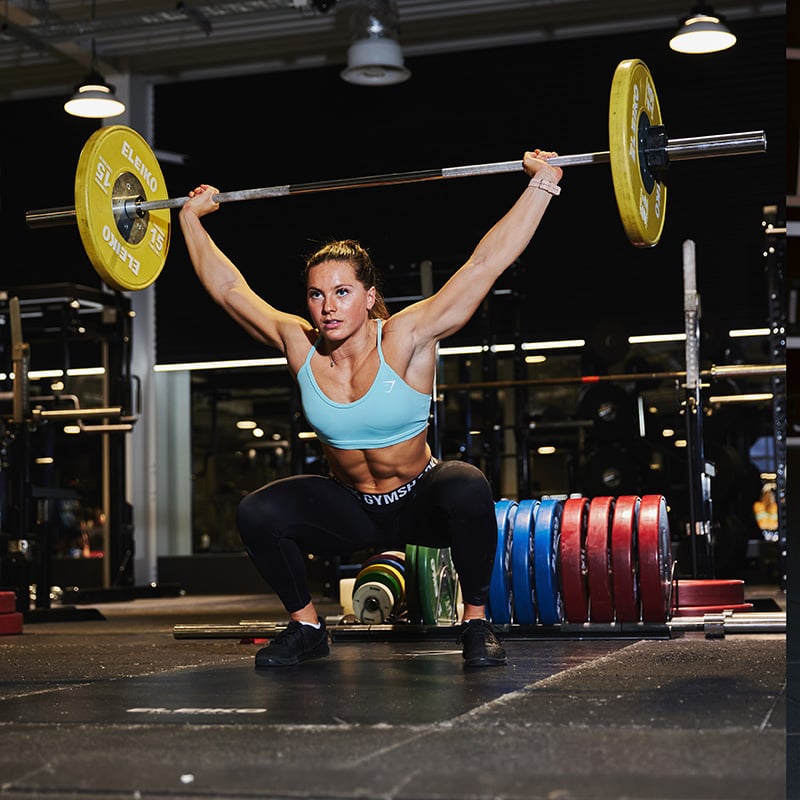
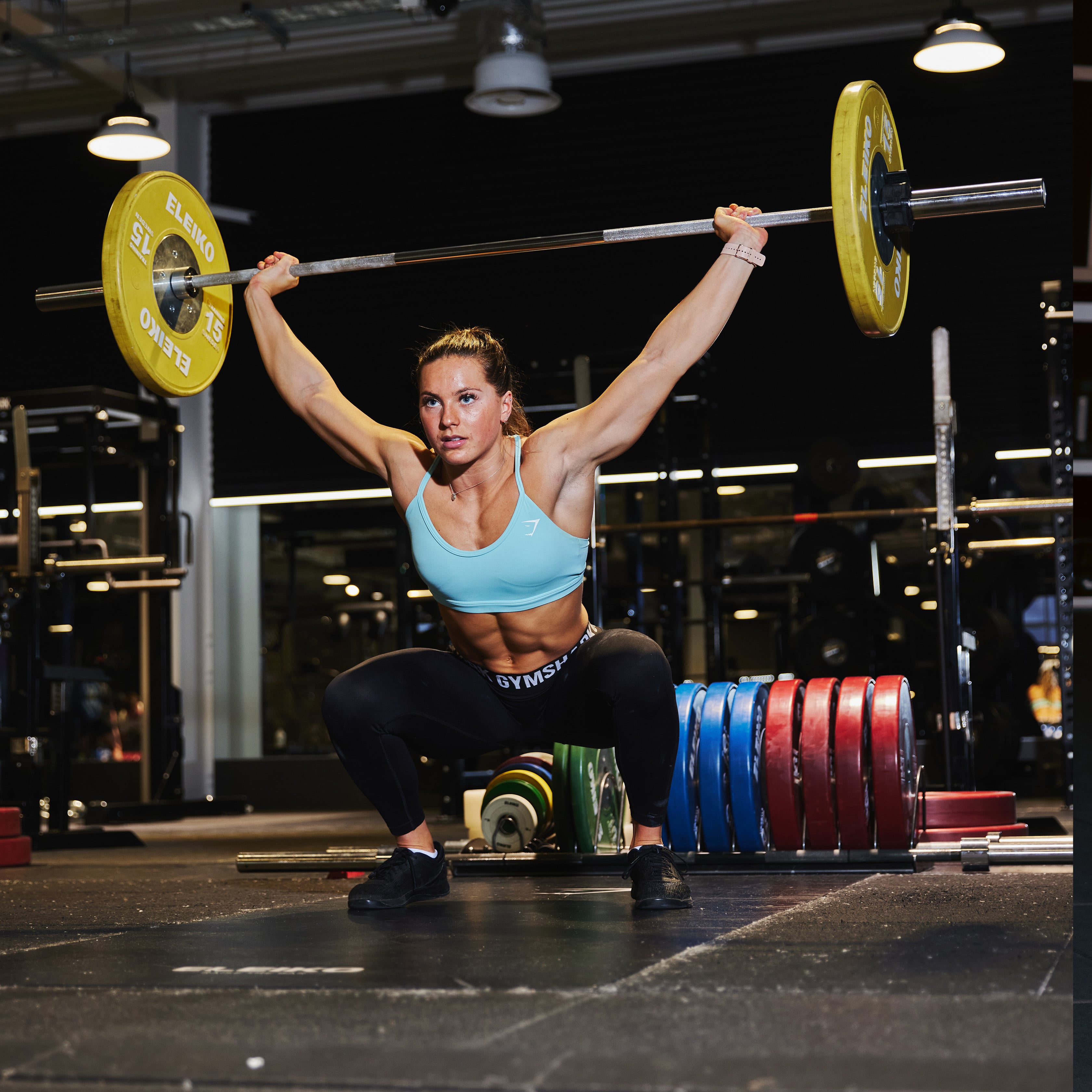
One second the bar’s on the floor, the next it’s overhead and you're in a deep squat wondering how Olympic weightlifters and functional fitness athletes make it look so effortless…
Just like any skill, mastering the snatch takes speed, strength, flexibility, and a whole lot of practice… and then more practice. But the satisfaction of landing solidly in the catch–and the full-body strength and muscle you’ll build along the way–is hard to match.
So, if you’ve landed here looking for where to start, you’re in the right place. Even if you’ve done snatches before, the snatch progressions we’re about to share are perfect for building confidence, strength, and stability—especially in those common weak spots that can make or break your lift.
We’ll walk you through what a snatch is, how to do it, and the best drills to help you master the movement. We’ll also cover the most common mistakes and exactly how to fix them.
So if you’ve been dodging snatch day, or getting frustrated at making the same mistakes time and time agai–this guide’s for you.
@ameliepelta 🫶🏼🫶🏼🫶🏼 #fyp #foryoupage #weightlifting #olylifting #training #gymshark #gymgirl #gymtok ♬ Replay speed up - Fatality.
What Is the Snatch?
The snatch exercise is a complex barbell movement that engages the entire body. It became an Olympic weightlifting exercise back in 1896 at the Athens Olympic Games. Originally a one-handed lift (crazy, right? 🤯), it’s now one of the two competition lifts in Olympic Weightlifting (alongside the clean and jerk) and is commonly used in functional fitness classes for conditioning, athleticism, and skill development.
The exercise takes the bar from the floor to overhead in one smooth, continuous motion–it’s one of the most complex exercises you will probably ever learn, but it’s also one of the most rewarding.
But one type of snatch isn’t enough–there are actually multiple variations of the snatch, each with slight differences in how the lift is performed:
Squat Snatch: This is type of snatch most people mean when they talk about the snatch–This takes the bar from the ground, to overhead, while you drop down into a deep squat to catch.
Power Snatch: This snatch variation also takes the bar from the floor, but you catch it in a partial squat or "power" position—meaning the hips are higher and knees are only slightly bent.
Hang Squat Snatch: This variation starts from the ‘hang’ position (bar just above the knees). From there, the bar is taken overhead and caught in a deep squat.
Hang Power Snatch: Similar to the hang squat snatch, but instead of dropping into a full squat, the bar is caught in the power position with a slight knee bend.
Dumbbell Snatch/kettlebell snatch: A variation of the barbell power snatch (or hang power snatch), usually done using one arm. The kettlebell or dumbbell is lifted from the ground (or from the hang position) and swung overhead, ending with the elbow locked out.
FYI: When people refer to the ‘snatch’, they are usually referring to the ‘squat snatch’, unless they say otherwise!
How To Snatch
There are 5 individual stages to the snatch, which are:
Setup and Starting Position
First Pull
Second Pull
Catch
Stand Up to Finish
Although these are performed in one fluid motion, understanding the different phases of the barbell snatch allows us to focus on particular areas, identify our weaknesses, and put in the hard work to improve specific phases.
1. Setup and Starting Position
Foot Position: Stand with your feet about hip-width apart, with your toes slightly turned out.
Hand Placement: The snatch uses a wide grip, typically somewhere between the inner and outer knurling on the barbell [1]. The exact width depends on your arm length and comfort, but the goal is to have your arms fully extended overhead with the bar balanced comfortably. (see ‘how to find your ideal grip’ below)
Grip: A hook grip is used for Olympic lifts such as the snatch. It keeps the bar more secure in your hands and creates better control. To hook grip, wrap your thumb around the bar, then wrap your index and middle fingers over your thumb, so your thumb is trapped between the bar and your fingers — like a “hook.” This position can initially feel uncomfortable, but becomes second nature over time.
Bar Position: The bar should be directly over your midfoot, almost touching your shins.
Body Alignment: Hips below shoulders, chest up, lats engaged, and eyes looking forward or slightly down. Your back should be flat and tight—think about showing your logo on your shirt.
How To Find Your Ideal Grip:
Stand tall holding an empty barbell with your hands wide and arms fully straight.
Lift one knee toward your chest, like a high march.
If your arms bend or you feel tension, your grip is likely too narrow.
Gradually adjust your grip wider and practice marching again until you can lift your knee while keeping your arms straight.
2. First Pull
This phase moves the bar from the ground to just above the knees.
Create tension on the bar and engage your lats, by thinking about twisting your hands outward slightly on the bar—as if you’re snapping a stick.
Begin the movement by pushing through your legs to lift the bar.
Keep your chest over the bar, arm straight, and back angle the same.
As the bar rises,
actively push your knees and shins back
to allow the bar to move vertically and stay close to your body.
The bar should stay close to your body, rising in a straight line.
3. Second Pull
This is the most explosive phase—where power is created. Researchers analysing the heaviest successful snatches from 7 gold-medal-winning women at the 2010 World Weightlifting Championships found this phase to be the most powerful phase that was much faster compared to the first pull [2].
As the bar passes the knees, extend your hips and knees forcefully.
Shrug your shoulders and rise onto your toes.
Keep the bar close as you begin to pull yourself under.
4. Catch
This is where you receive the bar overhead—in a squat (for a full snatch).
Pull yourself under the bar quickly and drop into a full overhead squat.
Catch the bar with your arms locked out, shoulders active, and core engaged. Keep your chest up and gaze forward / slightly up.
Hold this position for a second (don’t rush to stand up), pressing out on the bar throughout.
5. Stand Up to Finish
This is the final phase—standing up from the squat to complete the lift.
Drive through your heels to rise from the squat.
Keep the bar stable and locked out overhead.
Finish tall with your feet under your hips and the bar directly above midfoot.
Make sure you're fully stood up before dropping the bar.
Benefits Of Learning The Snatch
Sure, mastering the barbell snatch looks impressive, but there are actually many benefits beyond this that make it well worth the time in learning:
Builds full-body power and strength
Improves coordination and body control
Builds strength and speed
Boosts mobility and flexibility
Provides metabolic conditioning (when used in circuits of functional fitness-style WODs)
Mastering the snatch has a high carryover to other lifts (e.g., improving your clean, jerk, and squat)
Muscles Worked By The Snatch
The snatch movement is nothing like those exercises that focus on a single muscle group (hamstring curls, tricep press-downs, etc.)—it is one of the most complete, full-body lifts out there, recruiting nearly every major muscle group through different phases of the movement.
Lower Body: Glutes, hamstrings, quads, calves
Back & Posterior Chain: Erector spinae (Lower Back), traps (Upper Back), lats
Shoulders & Arms: Delts, rotator cuff, biceps, and forearms
Core: Rectus Abs & obliques, transverse abdominis (deepest layer of ab muscles), spinal stabilizers
Snatch Mistakes To Watch Out For
Whether you’re new to snatches or you’ve been practicing for a while, these are some of the most common mistakes you might experience.
Try to film yourself, then watch the video back in slow motion (or get a coach to watch it, too), paying close attention to any of the following happening:
1. The Bar Drifts Too Far From The Body
The bar swings away from your torso during the pull, usually from not engaging your lats or pulling with your arms too early.
Fix ➡️ Aim to keep the bar as close to your body as possible: The bar path should be vertical throughout the whole movement. Think: letting the bar ‘brush up your t-shirt’ during the second pull.
2. Pulling With Arms Instead Of Legs/Hips
You see your elbow bend and pull the bar, before your hips have fully extended.
Fix ➡️ Keep your arms relaxed and straight. Think of your arms as ropes: You don’t need to bend them; just focus on extending your hips, shrugging the bar up, and pulling under.
3. Poor Positioning In The Catch
Your heels lift off the ground, knees cave in, or lower back arches, which leads to the bar falling forward.
Fix ➡️ Think about punching up into the bar and showing your armpits forward. Make sure you are looking forward/slightly upwards. Don’t rush out of the catch: Sit in the catch for a second or two, make sure you are fully stable, and then stand up. It may also help to work on some lat and thoracic spine mobility.
Beginner Snatch Progressions
As a beginner, it’s better to break the snatch exercise down into smaller, more focused movements, which will make the whole exercise easier to understand.
That being said, these exercises are excellent snatch drills to return to, even as you become more experienced with barbell snatches, particularly if you’re experiencing any of the form mistakes above. These snatch drills can help strengthen weak points in the movement to improve your Olympic snatch technique.
Try these snatch progression drills (using a PVC pipe or empty barbell initially) to help you learn the full snatch lift:
Snatch pull
Hang power snatch
Overhead squat (OHS)
Snatch balance
Tall snatch
1. Snatch Pull
The snatch pull is a foundational snatch exercise that mimics the first and second pull of the snatch—without catching the bar overhead. This builds strength and reinforces bar path, timing, and powerful hip extension, teaching you to keep the bar close and generate vertical force using the legs and hips, not the arms.
How to do it:
Get set–Stand with the bar over the middle of your feet, take a wide snatch grip, and keep your back tight and chest up.
First pull–Push the floor away with your legs to lift the bar to knee height, pushing your shins back as you do so.
Second pull (explode)–Once the bar passes your knees, drive your hips forward by squeezing your glutes and moving your hips toward the bar, straightening your legs at the same time. Think of it like a powerful jump to send the bar upward.
Shrug–As your hips finish extending, shrug your shoulders strongly toward your ears, keeping your arms straight so all the power comes from your legs and hips.
Lower with control–Guide the bar back down to the floor smoothly, reset, and repeat.
2. Hang Power Snatch
A simplified snatch variation that starts from the "hang" (just above the knees) and finishes with a catch overhead without a squat. This removes the complexity of lifting from the floor and focuses on the second pull, teaching you to explode the bar upward with hip extension and finish in the power (quarter squat) catch position.
How to do it:
Start position–Stand tall holding the bar in a wide snatch grip at hip height. Push your hips back (like you’re closing a car door with your bum) and lower the bar until it’s just above your knees. Keep your back straight—this is your “hang position.”
Keep it close–Keep the bar close to your thighs and squeeze your shoulder blades down and back (like you’re tucking them into your back pockets) to engage your lats.
Explode up–Push hard through your feet, squeezing your glutes and driving your hips toward the bar as your knees straighten.
Get under the bar–As the bar rises, shrug your shoulders, then quickly pull yourself underneath it, bending your knees slightly as you land.
Catch and stand–Catch the bar overhead with your arms straight and strong, then stand tall to finish the lift.
3. Overhead Squat (OHS)
An overhead squat is literally what it says on the tin: A squat with the bar held overhead in a snatch-width grip throughout the movement. The movement builds mobility, shoulder stability, and confidence in the catch position and strengthens the bottom of the snatch.
How to do it:
Grip and press–Begin with the bar resting across your upper back and shoulders (back rack position), hands in a wide snatch grip.
Dip and drive–Then, dip (by bending your knees slightly, driving them out), then extending your legs, squeeze your glutes and use the momentum to press the bar overhead. Ensure your elbows are fully locked out, press ‘up’ into the bar and actively “pull the bar apart” as if you’re trying to bend it into a rainbow.
Foot position–Place your feet in your squat stance (about shoulder-width apart, with your toes turned slightly out.
Brace and align–Tighten your core like you’re about to be poked in the stomach, and keep the bar directly above the middle of your feet—this is your balance point.
Squat with control–Slowly lower yourself into a squat, keeping your chest up and eyes forward. Keep your arms “active” by pushing up into the bar the whole time. Aim to go as low as your mobility allows—ideally until your hips are just below your knees—while keeping your chest proud and heels on the ground.
Stand tall–Push through your heels to stand back up, keeping the bar stable and directly overhead the entire time.
4. Snatch Balance
A dynamic movement that begins with the bar on your upper back. You dip, drive, and drop under the bar into a full overhead squat. The snatch balance is often used by beginners learning the snatch as a progression towards learning the full snatch, and by lifters who already know how to do a full snatch, but struggle with positional strength, timing, or confidence in the catch [3].
The snatch balance builds speed and coordination in the drop, teaching you to commit to the catch and stabilize the bar under load.
How to do it:
Start position–Place the barbell across your upper back (on your traps). Stand with your feet about hip-width apart and hold the bar with a wide snatch grip, hands far apart. Keep your chest up and back straight.
Dip down–Bend your knees a little, keeping your torso upright and driving your knees out.
Drive up and drop down–Push hard through your feet to stand up quickly, and at the same time, drop your body down under the bar into a deep squat, aiming to get your hips below your knees.
Punch the bar up–As you drop into the squat, press the barbell straight up over your head and lock your arms out strong.
Stand up tall–Hold the bar steady overhead and carefully stand all the way up to finish the lift.
5. Tall Snatch
The tall snatch is a snatch drill with zero leg drive—you start tall, bar at hips, and immediately pull under the bar. It's all about the turnover, forcing you to be fast under the bar and to avoid early arm pulls, teaching you timing, relaxation, and commitment to the bottom position.
How to do it:
Start position–Stand tall holding the barbell at your hips. Place your feet about shoulder-width apart, set up like you would for a squat. Keep your chest up and back straight.
No dip, just shrug–Instead of bending your knees or jumping, keep your legs straight and simply shrug your shoulders to start pulling the bar up. Keep the bar close to your face and bend your elbows as you pull.
Pull yourself under–As the bar rises, quickly drop down into a deep overhead squat, getting your hips below your knees.
Keep the bar close–Catch the bar overhead with your arms fully locked out and strong, pressing up into the bar and keeping your gaze forward or slightly upwards.
Stand up tall–From the deep squat, stand up carefully while holding the bar steady overhead. Then reset and get ready for the next rep.
Snatch Programming Tips For Beginners
How often to practice: 1 to 3 times a week is ideal (leaving at least a day between each snatch workout)
How many reps/sets to start with: Opt for low reps, 3 to 5 sets of 2 to 3 reps at light to moderate weights. Focus on skill first, over how much you can lift.
What weight to use: Begin with a PVC pipe or a light dowel rod to practice the movement pattern without any load. This helps you focus on form, footwork, and bar path without the pressure of weight. Once comfortable, progress to an empty barbell (usually 44 lbs or 33 lbs for women) to get used to the feel and grip of the bar.
Adding weight: When you start adding weight, increase in small increments—for example, 2.75 lbs or 5.5 lbs plates—so you can maintain good technique without overloading too quickly. Avoid jumping to heavy weights too fast. If possible, use bumper plates that can be dropped safely and provide a consistent start position.
Sample Beginner Snatch Session
Warm-Up
Mobility Drills:
PVC Pass-Throughs (using a PVC pipe or broomstick) — 10 reps
Overhead Squat with PVC — 8-10 reps
Hip Flexor Stretch (Dynamic) — 5 reps each side
Ankle Mobility Drill — 10 reps each side
Activation and Movement Patterning:
Snatch Pull with PVC or empty barbell — 6-8 reps
Hang Snatch with PVC or empty barbell — 6 reps
Snatch Balance with PVC or empty barbell — 5 reps
Main Sets
A. Hang Power Snatch – 3–4 sets of 2–3 reps
Start just above the knees. Light weight (40–50% of estimated 1RM or empty bar + small plates).
Focus: Bar path, timing, smooth catch.
B. Full Snatch from Hang or Blocks – 3–4 sets of 2 reps
Catch in a full squat if mobility allows — or stay with power if needed.
Cue: “Explode up, pull under, strong overhead catch.”
Rest 60–90 seconds between sets. Film yourself or have a coach/training partner watch if possible.
Accessory Work (Optional)
Snatch-grip Romanian Deadlifts – 3x8 (Focus on hamstring stretch and bar control)
Plank with shoulder taps or side plank – 3x30 seconds (Build trunk stability for receiving the bar overhead)
Cool-Down
Child’s pose
Lying thoracic opener
Pigeon stretch or couch stretch (hips)
Deep squat hold – 1 minute
Mastering the Snatch Takes Time—But It’s Worth It
Learning how to snatch won’t come overnight–in fact, even the most experienced athletes continually work to fine-tune their technique. Learning how to snatch is not just a physical challenge but a mental one, requiring a ton of concentration, mobility, strength, and coordination.
The key to learning the snatch lift is to be consistent. Don’t get overly focused on the weight, but work on perfecting each phase of the lift, using the above progressions and drills to learn the movement correctly.
Don’t rush the process—each rep is an opportunity to improve.
Whether you’re training for Olympic weightlifting or functional fitness classes or want a new challenge and to switch up your routine, the snatch is a powerful addition to your training toolbox.
Whether it’s leggings that keep your shins protected during the first pull, split seam shorts that allow for full freedom of movement, or knee sleeves that help you drop into that deep squat with ease–we have the weightlifting equipment you need to help you reach that snatch PB.
FAQs
Is The Snatch Safe For Beginners?
Yes–if it’s taught and progressed correctly, and you don’t use too much weight, too soon!
As a beginner learning how to snatch, it’s best to start off using a PVC pipe and then an empty barbell. Learn the snatch lift in stages (as shown above), mastering each beginner snatch progression before attempting to learn the whole movement.
If possible, learn from a qualified coach (whether in a class or through personal training) or use a reputable program that includes mobility, adequate rest days, and slow progressions each week.
What’s The Difference Between Power Snatch And Full Snatch?
A power snatch is when you catch the bar in the ‘power position’ (a quarter squat with a slight bend in the knees). A full snatch refers to a ‘squat snatch’, where you catch the bar in a full squat. Both of these variations will refer to the barbell being taken from the floor instead of from a hang position (just above the knees).
A squat snatch makes it easier to lift greater weight because it uses a stronger, more stable catch position. However, many beginners learning how to snatch will first learn the power snatch to master the pull and bar path, building confidence and working on mobility to perform a full snatch.
How Much Weight Should I Use?
Go light when learning the barbell snatch! Use a PVC pipe or an empty barbell (33-44lbs) when learning–or even a training bar if an empty barbell feels too heavy. As a technical lift, you need to master the bar path, timing, catch position, and stability overhead before adding any major weights.
When adding weight, start with 5.5lbs on each side, then progress to 11lbs. Then, you can progress in small increments. Try to use bumper plates, rather than small plates, so the bar is at the correct distance off the ground and you can drop the bar safely.
Why Is the Snatch So Difficult?
The snatch is one of the most technical and demanding lifts in strength training. It requires full-body coordination, a blend of strength and speed, and excellent mobility through the shoulders, thoracic spine, hips, and ankles. With so much happening at once, it’s mentally challenging, and even the smallest error can cause a missed lift.
But that’s exactly what makes it so rewarding. Every rep is a skill, and there’s always something to improve. When the movement starts to click and you see progress, it’s one of the most satisfying feelings in training.
References:
[1] Himawan, M.K.N., Rilastia, D., Syafei, M., Nugroho, R. and Budihardjo, B. (2018). Biomechanical Analysis of Snatch Technique in Conjunction to Kinematic Motion of Olympic Weightlifters. [online] www.atlantis-press.com.
[2] AkkuŞ, H. (2012). Kinematic Analysis of the Snatch Lift With Elite Female Weightlifters During the 2010 World Weightlifting Championship. Journal of Strength and Conditioning Research, 26(4), pp.897–905.
[3] Altepeter, M. and Mike, J. (2017). Snatch Balance Technique. Strength and Conditioning Journal, 39(5), pp.82–88.