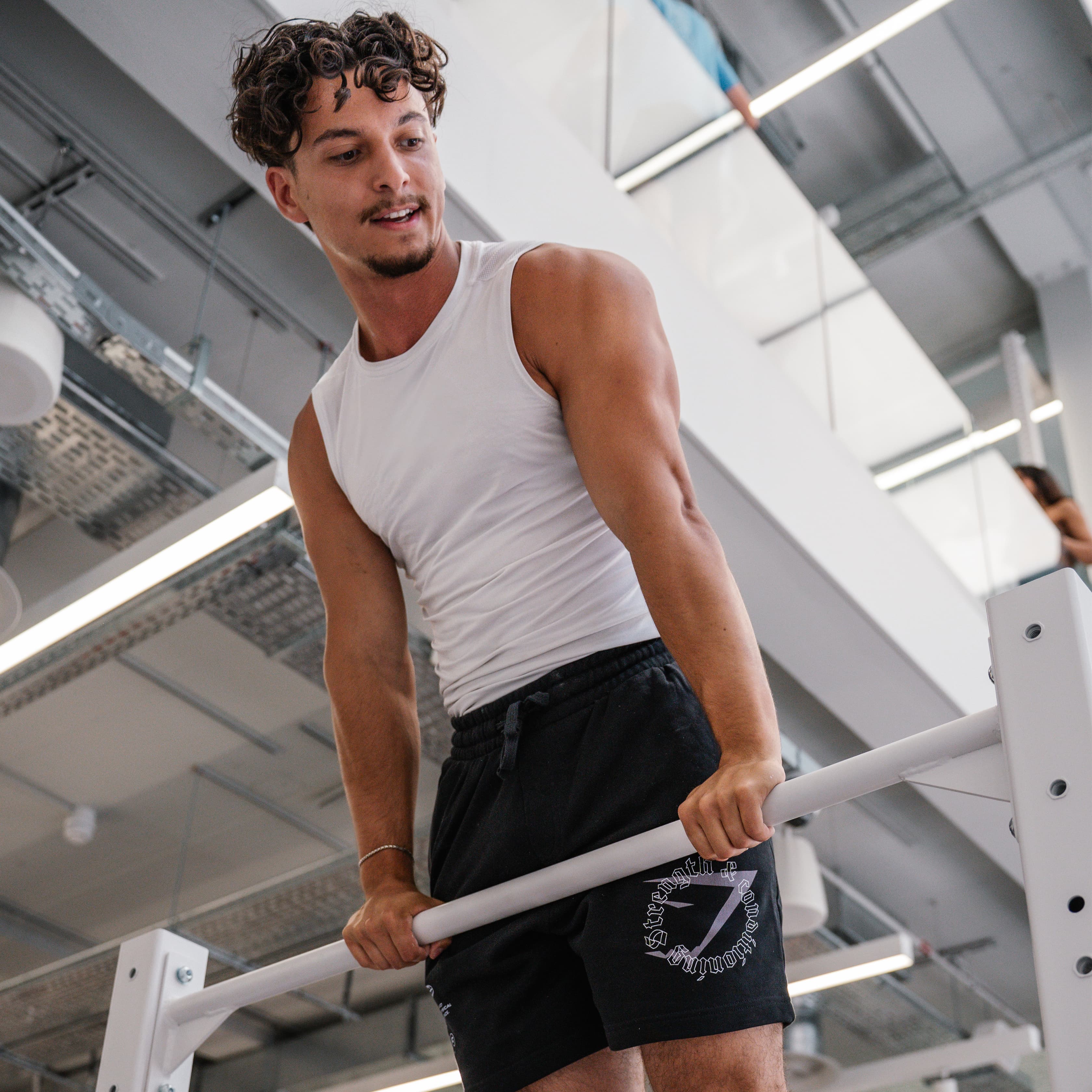

















As the year comes to a close, it’s the perfect time to check in on the goals you set back in January, and for many of us, getting our first pull-up was probably on that list. If you’ve nailed yours - congrats! But if you haven’t, don’t worry, this guide is designed to help you get that chin over the bar before the year’s end.
Pull-ups are infamous for being one of the trickiest bodyweight exercises, often referred to with a sigh and the classic line “I just can’t do them". After all, this is a full-body move that requires you to lift your entire bodyweight. Your lats have to fire, your arms need to pull, your grip-strength needs to stay locked, all whilst your core holds it all together- and if you’ve got long levers, the challenge just ramps up.
But while it can be frustrating trying to get your first pull-up, the good news is that they are achievable. With the right strategy, targeted exercises, and consistent practice, you can progress from assisted variations to full reps.
We’ll talk you through the biomechanics of a pull-up, how to do a pull-up with perfect form, key accessory exercises, and training tips that will help you level up your pull-ups, and maybe even smash your personal record before the year is out.
What Is A Pull Up?
A pull-up is a bodyweight pulling exercise where you hang down from a bar with an overhand grip (palms facing away), then pull your bodyweight up until your chin clears the bar.
It’s a compound upper-body exercise, meaning it works several muscle groups and joints at once - making it a highly effective movement for building overall upper-body strength. They engage your back muscles (like the latissimus dorsi and trapezius), biceps, forearms, and core to pull your body weight up.
Pull-ups train your:
Lats (latissimus dorsi): Act as the prime movers (main drivers) of the pull-up, responsible for drawing your arms downward and back to pull your body up to the bar.
Biceps: Play a significant supporting role as synergists, assisting the lats in flexing the elbow joint during the upward phase.
Upper back (rhomboids and traps): These muscles are crucial for stabilizing the scapula (shoulder blade) and retracting it (pulling it together) to ensure proper shoulder mechanics and posture throughout the movement.
Forearms and grip muscles: Act as stabilizers that allow you to maintain your grasp on the bar, with the forearm muscles also assisting in elbow flexion.
Core (especially the rectus abdominis): Provide full-body stabilization to prevent swaying and maintain a rigid, efficient body position during the exercise.
One comparative study even showed the rectus abdominis had the highest activation of all muscles tested during pull-ups [1]. Translation? Your core is doing more than just “helping”; it’s the key to staying stable and preventing swinging.
Because they use multiple muscles and joints together, pull-ups are a great way to build functional strength that translates to everyday movements.
How To Do Pull-Ups: Step-by-Step Guide
Pull-ups aren’t just about upper-body strength; they’re about keeping your body stable and driving power through your lats. That means bracing your abs, switching on your glutes, and taking a grip that sets you up for rep after rep. Use these cues as your blueprint:
1. Set Your Grip
Your grip is your anchor, and the way you set your hands will decide how well your lats switch on.
Grab the bar slightly wider than shoulder-width with an overhand (pronated) grip
Make sure knuckles are stacked on top of the bar
Wrap thumbs around the bar for maximum control
Grip with your palm, not your fingertips
Cue: Imagine trying to bend the bar in half. This engages your lats before you even move.
PT Note: If your reps fall short of full range, it’s better to use partials plus controlled negatives instead of rushing through messy full reps.
2. Establish Your Hang
Your dead hang sets the foundation for the entire rep. It’s where you create the tension that stops swinging, saves your grip, and makes the rep more efficient.
Keep your arms straight
Shoulders gently pulled down (active, not shrugged)
Ribs stacked over the pelvis
Legs stretched out long or softly bent behind you
Core braced - like you’re zipping your ribs toward your hips
Squeeze your legs together and lightly tuck your tailbone to switch on your glutes
This tension prevents you from flopping messily under the bar and keeps every rep clean and controlled.
3. Initiate With Your Scapula
This is the part most people skip, and it’s why they never get stronger, but this tiny movement can change everything.
Before you even think about bending your elbows:
Pull your shoulders down and back
Create a tiny upward lift
Feel your lats engage
This “scapular pull-up” (retraction + depression) primes the lats more efficiently and reduces wasted movement when you pull, making your pull-up smoother and more efficient [4].
4. Pull Yourself Up
Now initiate the full rep:
Drive your elbows down and behind you
Lift your chest toward the bar
Keep your ribs tucked so you’re not arching through your lower back
Maintain tension through your abs and glutes
No swinging or knee kicks
Pull yourself up until your chin clears the bar
Cue: Don’t think about pulling your chin up; to get the angle right, think about pulling your ribcage toward the bar.
PT Note: Slow reps > fast reps. Controlling the path up makes it easier to control the path down (where half your strength gains come from).
5. Lower With Control
The lowering portion is where most of the strength is built, and research on eccentric training shows it’s one of the fastest ways to increase pulling strength [5].
Lower for 2–3 seconds
Keep your body tight (don’t collapse at the bottom)
Straighten your arms fully
Keep your shoulders slightly active so you don’t shrug at the bottom
Other Pull-Up Variations
Tweaking your grip can target different muscles, challenge your strength in new ways, and keep your workouts fresh. Here’s the breakdown:
Close-Grip Pull-Ups:
Hands close together (underhand or overhand) shift more emphasis onto the biceps, forearms, and inner lats. They’re great for arm strength and a slightly easier pull for beginners.
Wide-Grip Pull-Ups:
Hands placed wider than shoulder-width focus more on the outer lats and upper back, making the move harder and giving that wider “V-shaped” back appearance.
Regular Pull-Ups:
Hands shoulder-width apart with palms facing away (overhand), targeting the middle lats, biceps, and upper back. This is the classic all-around pull-up that builds balanced upper-body strength.
Pro Tips To Improve Your Pull Up Form - From A Gymshark PT
We spoke to Josh Carr, a Senior Fitness Pro at Gymshark to get his take on the cues that actually move the needle.
1. Stabilize Your Lower Body
A solid pull-up starts with reducing swing. When your legs drift or flay, your body stops moving as one unit, and instead of your back and arms pulling your weight straight up, some of your effort gets wasted trying to control momentum. This is what we call “leaked force,” and it means your lats have to work harder for less return, which makes each rep feel heavier and less controlled than it needs to be.
Squeezing your legs together, bracing your abs, and holding a strong hollow-body shape increases your whole body tension and core stiffness = improved force transfer in vertical pulling movements [10].
Josh adds: “Try tucking your tailbone in and squeezing your glutes for extra stability.”
2. Control Every Rep
Slow reps beat fast ones for building strength.
Slowing down increases time under tension, especially on the lowering phase, which is linked to better muscle growth and pulling strength.
Aim for a smooth pull-up and a controlled 2–3 second descent. If you’re dropping fast at the bottom, you’re missing one of the biggest strength-building opportunities in the lift.
3. Get Your Grip Right
A proper pronated grip sets you up for cleaner reps. Keep your knuckles on top of the bar and thumbs wrapped underneath. This will help improve control and help engage the lats earlier. This position also reduces over-reliance on the biceps, which is a common reason people struggle with pull-ups.
Think strong hands, active shoulders, relaxed neck, and pull.
4. Use Partials (Then Negatives)
A partial rep means working through the range of motion you can control, even if you can’t complete a full pull-up yet.
Partial pull-ups allow you to build strength at specific joint angles, e.g half-way to the bar, which can help with full-range performance over time. Pairing them with slow negatives helps reinforce that strength through the entire movement pattern.
So in practice: pull as high as you can with control, then finish with a slow 3-5 second negative. This bridges the gap between where you are and your first full rep.
5. Train Your Core as It Matters
Pull-ups aren’t just a back exercise. Research shows that the rectus abdominis is one of the most active muscles during pull-ups, working hard to stabilize your body and prevent swinging as you pull [1].
Josh notes: “The abs are actually the muscle most active during pull-ups. If your core isn’t strong, you’ll always feel like the movement is harder than it should be.”
Train your core alongside your pull-ups, and everything will instantly feel more controlled.
@abbiedennisonfit EFFORTLESS PULL UPS WORKOUT Do this workout once per week, and add the pull up specific exercises to a second upper body day if you’re really serious about making progress! ⭐️ Pull ups 3xAMRAP (use a band if needed) ⭐️ Slow negatives 3xAMRAP ⭐️ Isometric holds 3xAMRAP ⭐️ Barbell row 3x5-6 reps ⭐️ Lat pulldown 3x6-8 reps ⭐️ Barbell bicep curl 3x8-10 reps ⭐️ Dumbbell hammer curls 3x10-12 reps Wearing @R.A.D® ♬ original sound - Abbiedennison
How To Get Better At Pull Ups: 5 Exercises To Try
Struggling to hit your first pull-up, or just want to rack up more reps? Strength isn’t built overnight, but with the right exercises, you can target the exact muscles, grip, and control you need to level up. These five moves are designed to build your lats, arms, core, and grip so that pull-ups go from a struggle to a standard part of your routine.
Lat Pull Downs
Think of lat-pulldowns as pull-ups with training wheels… but in a good way. Lat pull-downs mimic the same vertical pulling pattern but eliminate the challenge of lifting your full bodyweight. That means you can build strength where it matters most - in your lats, while developing more control of the tempo and nailing the mechanics you’ll need on the bar. Slow eccentrics here are especially effective, with research showing that the lowering phase plays a key role in building pulling strength [6].
How to do a Lat Pulldown:
Sit tall on the lat pull-down machine, adjust the thigh pads, and lock your thighs under the pads, feet flat on the ground.
Take a slightly wider-than-shoulder-width overhand grip.
Pull your shoulders down and away from your ears before you move — this is your lat engagement.
Keeping your chest up and back straight, lean back just 5–10 degrees (tiny hinge), with your ribs tucked in.
Drive your elbows down and squeeze your shoulders together as you pull the bar to the top of your chest.
Pause for a second at the bottom and feel your lats contract.
Slowly guide the bar back up for 2–3 seconds, letting your lats fully lengthen without shrugging.
💡 Study highlight: We know that seated lat pulldowns are a highly effective pull-up prep exercise, as they activate the rectus abdominis and biceps strongly. However, they don’t exactly match the full movement pattern of a pull-up, and there’s a better contender…
The kneeling lat pulldown at ~80% of bodyweight most closely mimicked pull-ups in muscle activation for less-experienced lifters - because it engages the hip and core in a similar way to a hanging position [1].
To perform it:
Position yourself directly in front of the lat pulldown machine, with the knees about hip-width apart.
Kneel on the floor or a padded mat so your hips are stacked under your shoulders.
Your hips should be positioned just behind the seat or platform, leaving enough space for your arms to pull freely.
Grip the bar slightly wider than shoulder-width.
Keep your torso tall, core engaged, and shoulders down and back.
Pull the bar toward your chest, then slowly return to the start while maintaining tension in your lats and core.
For further progression, you can perform lat pulldowns on an unstable surface to further improve pull-up endurance so that your muscles learn to coordinate more efficiently [9].
Inverted Rows
If pull-ups feel miles away, inverted rows are your stepping stone. They teach you how to pull with your whole body, not just your arms - so your core, lats, and upper back all start working together. They’re easier than pull-ups, but don’t let that fool you; they build the scapular control and mid-back strength you have to master to make pull-ups feel smooth. Adjusting your foot position makes these more challenging instantly, so progression is simple and beginner-friendly.
How to do an Inverted Row:
Set a bar at waist height, and position yourself underneath the bar.
Grip the bar with a shoulder-width overhand grip and walk your feet out so your body forms a straight line (or keep your knees bent at a 90 degree angle if you find it difficult; it’ll remove some resistance and make the pull a little easier).
Brace your core like you’re about to plank, ribs tucked down, abs engaged, glutes tight.
Pull your shoulder blades back and down to initiate the rep.
Drive your chest toward the bar by leading with your elbows, not your neck.
Pause briefly at the top, then lower yourself slowly for 2–3 seconds, keeping your body straight.
Farmer’s Carries
If you’re training for Hyrox, then you’ll already be familiar with this station's movement, and you’ll know that grip strength here is everything. When it comes to pull-ups, your back might be strong enough, but if your grip gives out early, the reps stop there. Farmer’s carries level up your grip strength fast, while also teaching you how to create full-body tension. How? Holding heavy weights for a distance forces your hand and forearm muscles into overdrive, building isometric tension and strengthening your entire grip. Pair that with the farmers carry full core activation, and you’ve got the perfect formula to prevent swinging.
How to do Farmer’s Carries:
Pick up a pair of heavy dumbbells or kettlebells and stand tall with them by your sides, gripping them tightly with your knuckles facing down and palms facing in.
Engage your core, pull your shoulders slightly back, and lock your ribs down, think tall and stacked.
Walk forward in slow, controlled steps, keeping the weights tight to your body.
Maintain a steady pace without leaning, swaying, or shifting side to side.
Place the weights down with control when your time or distance is up.
Banded Pull Ups / Assisted Pull Ups
If you want to practice the exact pull-up pattern without the full bodyweight demand, assisted and banded variations are your go-to. You get to move through a full range of motion, perfect your technique, and you can gradually reduce assistance until you’re lifting your bodyweight. Plus, slowing down the descent here lets you take advantage of eccentric-focused strength gains [5, 6].
How to do an Assisted Pull-Up:
Loop a resistance band around a pull-up bar, pull a box over to step up, and place a foot or knee in the bottom of the loop of the band.
Begin the banded pull-up in a controlled hang with your shoulders pulled down (active hang).
Drive your elbows down and back, and you pull your chest toward the bar.
Keep your ribs tucked and avoid arching or swinging through the rep.
Pause at the top with your chin over the bar.
Lower slowly for 2–4 seconds, returning to a full hang at the bottom.
Coaching cue: Try to keep your core braced and body tight to avoid swinging. This will help with momentum pulling.
Negative Pull Ups
Negatives are one of the fastest ways to build the strength needed for your first unassisted rep. You’re learning to become stronger in the lowering phase, so you can train through the full range of motion before you’re able to pull yourself up. Research consistently shows that eccentric training stimulates large strength improvements, which is why these are a staple in every pull-up progression plan [5,6].
How to do Negative Pull-Ups:
Stand on a sturdy box or step to get to the top position of the pull-up with your chin over the bar
Grab the bar firmly (alternatively, you can jump to get into this position)
Pull your shoulders down and brace your core to lock your body in place.
Start lowering yourself in slow motion, aiming for a 3–6 second descent.
Keep your legs still and your body tight, no dropping or swinging.
Lower to a full hang with straight arms before stepping back up for the next rep.
Benefits Of Pull-Ups
Builds functional strength:
Develop serious back width and definition:
Pull-ups (especially with a wider grip) are excellent for targeting the lats and building that coveted V-shape and back width.
Improve shoulder strength + stability:
These pulling movements engage the scapular stabilizers and rotator cuff muscles, which help build vertical pulling strength, shoulder alignment, scapular control, and joint stability.
Builds grip strength fast:
Holding your entire bodyweight up (hangs + dead hangs) is one of the most efficient ways to build grip strength and endurance quickly [2].
Create better posture:
Pull-ups help strengthen the posterior chain muscles (muscles along your back), which help counteract the “rounded shoulder” forward posture common from sitting all day, promoting a more upright and healthy spinal alignment [3].
Transfer well into rowing, climbing, and everyday pulling strength:
Master pull-up mechanics and you’ll perform better at rowing (pulling force) and climbing (grip strength, vertical pulling, and bodyweight control).
Makes you feel strong in a way no machine ever quite captures:
Lifting the weight of your own body requires total body tension and core engagement that often feels more "functional" and empowering than machine-based exercises.
FAQs
What’s the difference between pull-ups vs chin ups?
Pull-ups use an overhand grip (palms facing away), which puts more load through your lats, upper back, and mid-traps. They’re typically harder because the grip position takes your biceps out of the movement, and without the arms, the back muscles have to step up.
Chin-ups use an underhand grip (palms facing you), which allows your biceps to work more and feels easier and more natural for many. Many lifters find that they can do more chin-ups than pull-ups.
Think:
Pull-up = best for building a wider, stronger back.
Chin-up = best for building arm strength. Beginner-friendly.
How many pull-ups should I be able to do?
One study found that performance on the lat pulldown strongly correlates with pull-up performance, meaning if your pulldown strength goes up, your pull-ups usually follow [7]. That’s why accessory work counts.
Don’t be disheartened if your numbers drop; just remember that consistency is key with pull-ups. If you let it slip, your reps will too.
Beginners: 1–3
Intermediate lifters: 5–10
Advanced: 10–15+
Highly trained athletes: 15–20+
How long will it take to get my first pull-up?
Most people see results within 4–12 weeks with consistent practice.
But there are a lot of varying factors; grip strength, bodyweight, training frequency, and whether you're doing the right progressions all play a role in how quickly you’ll advance.
A good rule: Train smart (not just “more”), build controlled eccentrics, and keep your volume consistent, and your first rep will arrive way faster than you think.
Is getting your first pull-up harder for women?
It can be, but not because women are “weaker.” It’s mostly relative strength.
Men typically start with more upper-body muscle mass, while women often have more lower-body development. That means women may need to build more baseline pulling strength before they can get their first rep [8].
But the gap closes quickly with structured practice, and many women have the advantage of having less bodyweight to actually pull.
Performance on the lat pulldown predicts pull-up ability, and since machines can be less intimidating, this can be a great starting point to excel at your pulling mechanics.
So yes, the starting point may be different, but the ability to achieve pull-ups is the same.
How often do I need to practice pull-ups?
Practicing pull-ups 2–3 times a week works best for most people.
You need enough volume to build strength… but enough recovery time for your lats, biceps, and grip to actually adapt.
Try spreading your sessions like this:
Day 1: pull-up progressions (banded, eccentrics, active hangs)
Day 3: accessory back work (rows, pulldowns, scapular strength)
Day 5: repeat progressions or do a lighter skill-focused session
Are pull-ups harder if you have long arms?
Yes, actually. Having long arms does usually make pull-ups harder.
Why? Because a longer arm means a longer range of motion, which means:
more distance to travel
more time under tension
a tougher leverage position at the bottom
Final Thoughts
Pull-ups are one of the ultimate strength milestones - the cornerstone of calisthenics and bodyweight training, testing your full-body strength, control, and coordination. Progress may feel slow at times, but every assisted pull-up, inverted row, or controlled negative is building the foundation you need for your first full rep.
Remember: consistency beats overdoing it. Focus on controlled reps, train your lats, grip, and core, and celebrate the small wins along the way. With structured practice, the right progressive exercises, and patience, that first pull-up isn’t just a goal, it’s an inevitable achievement.
So grab the bar, engage your lats, brace your core, and trust the process! You’ve got this.
References:
Almada, F., Fernando, C., Lopes, H. and Vicente, A. (2018) ‘Operationalization of the “Human Body Domain”: A structural and functional conception’, Journal of Physical Fitness, Medicine & Treatment in Sports, 4(2). Available at: https://juniperpublishers.com/jpfmts/JPFMTS.MS.ID.555669.php
López-Rivera, E. and González-Badillo, J.J. (2019) ‘Comparison of the effects of three hangboard strength and endurance training programs on grip endurance in sport climbers’, European Journal of Sport Science, 19(5), pp. 660–667. Available at: https://pmc.ncbi.nlm.nih.gov/articles/PMC6458579/
Somauroo, J., Murray, J. and Turner, A. (2017) The effects of a calisthenics training intervention on posture, strength and body composition. Available at: https://www.researchgate.net/publication/317321468_The_effects_of_a_calisthenics_training_intervention_on_posture_strength_and_body_composition
Prinold, J.A.I. and Bull, A.M.J. (2016) ‘Scapula kinematics of pull-up techniques: Avoiding impingement risk with training changes’, Journal of Science and Medicine in Sport, 19(8), pp. 629–635. Available at: https://pubmed.ncbi.nlm.nih.gov/26383875/
Stien, N., Nunes, J.P., Fonseca, R.M. and Saeterbakken, A.H. (2023) ‘Electromyographic comparison of pull-up variations’, Journal of Sports Science and Medicine, 22(2), pp. 288–296. Available at: https://jssm.org/volume22/iss2/cap/jssm-22-288.pdf
Youdas, J.W., Amundson, C.L., Cicero, K.S., Hahn, J.J., Harezlak, D.T. and Hollman, J.H. (2008) ‘Surface electromyographic activation patterns and elbow joint motion during pull-up, chin-up, and perfect-pullup™ exercises’, Journal of Strength and Conditioning Research, 24(12), pp. 3404–3414. Available at: https://pubmed.ncbi.nlm.nih.gov/18981046/
Dickie, J.A., Faulkner, J.A., Barnes, M.J. and Lark, S.D. (2009) ‘Electromyographic analysis of muscle activation during pull-up variations’, Journal of Strength and Conditioning Research, 23(7), pp. 2040–2044. Available at: https://pubmed.ncbi.nlm.nih.gov/19387371/
Pate, R.R., Wang, C.Y., Dowda, M., Farrell, S.W. and O’Neill, J.R. (2009) ‘Relationship of lat pull-down repetitions and pull-ups’, Journal of Strength and Conditioning Research, 23(5), pp. 1440–1446. Available at: https://journals.lww.com/nsca-jscr/fulltext/2009/05000/relationship_of_lat_pull_repetitions_and_pull_ups.43.aspx
Csapo, R., Alegre, L.M., Baron, R. and Gallasch, E. (2024) ‘Neural adaptations following bodyweight resistance training’, Journal of Sports Sciences, [online]. Available at: https://pmc.ncbi.nlm.nih.gov/articles/PMC11667758/
Grgic, J., Schoenfeld, B.J. and Mikulic, P. (2022) ‘Effects of resistance training frequency on muscular strength and hypertrophy’, Medicina, 58(8). Available at: https://www.mdpi.com/1648-9144/58/8